What Is NAD+? The Molecule Your Body Can’t Live Without
13 August 2026
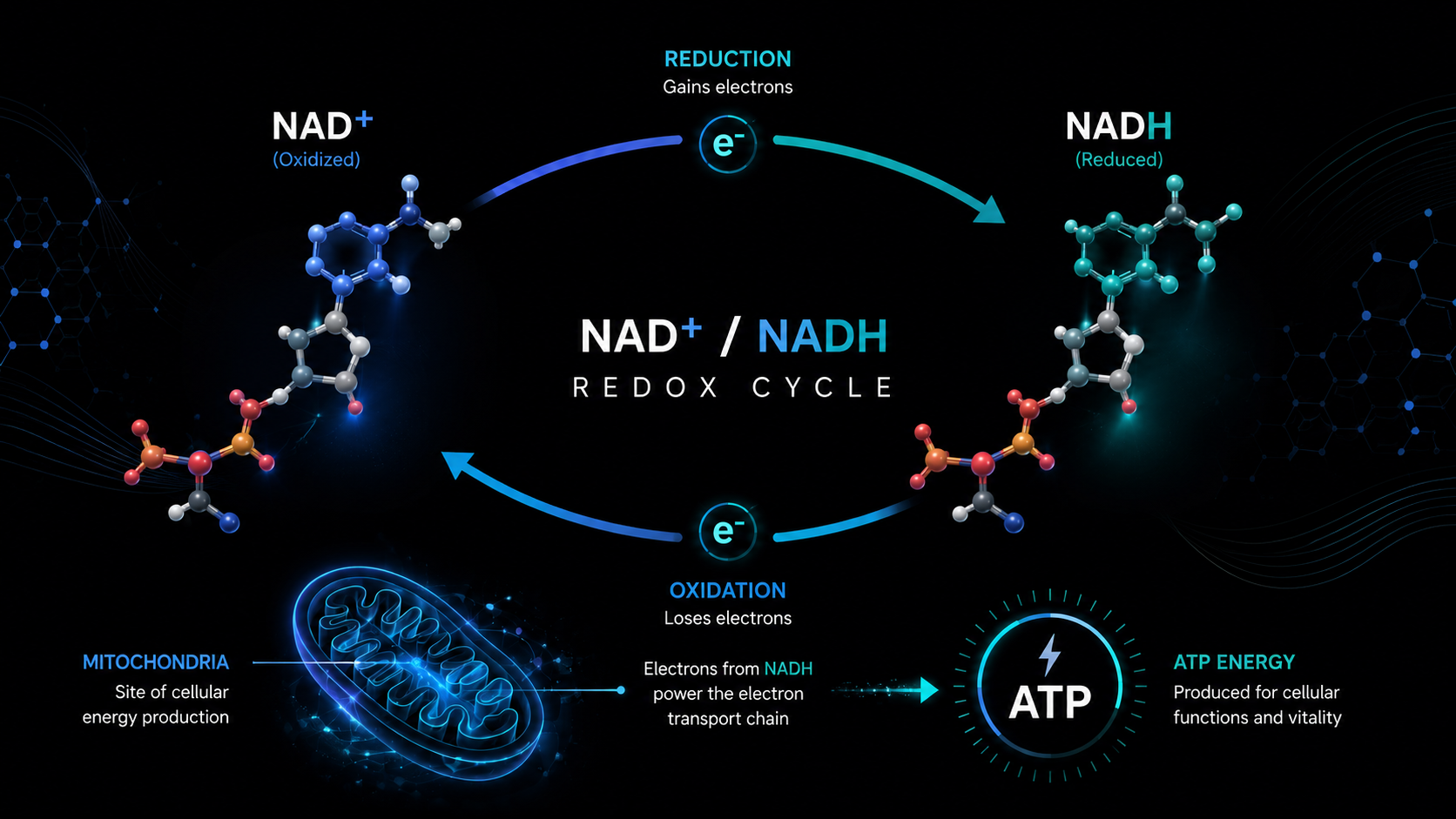
NAD+, or nicotinamide adenine dinucleotide, is a coenzyme present in every human cell that enables the chemical reactions cells use to produce usable energy. It works mainly by shuttling electrons during metabolism, cycling between an oxidised state (NAD+) and a reduced state (NADH) as nutrients are converted into ATP. Beyond energy metabolism, NAD+ is consumed by enzyme families that govern DNA repair, gene expression and cellular stress responses. Because these processes touch nearly every part of cell function, NAD+ metabolism has become one of the most closely studied areas in cellular biology and ageing research — though many questions about its practical significance in humans remain genuinely open.
What Is NAD+?
NAD+ is a dinucleotide: two nucleotide units, one built around a nicotinamide ring (a form of vitamin B3) and the other around adenine, joined through a pair of ribose sugars and a shared phosphate linkage. This structure gives NAD+ its central biochemical role as an electron carrier — it accepts a hydride ion to become NADH (the reduced form), then donates that hydride elsewhere to return to NAD+ (the oxidised form). Cells rely on this constant interconversion to move electrons between the reactions that release energy from food and the reactions that use that energy.
The molecule was first identified in 1906 by British biochemists Arthur Harden and William Young, who found that a heat-stable component of yeast extract accelerated fermentation. Its biological importance became clearer through the following decades, notably when researchers linked NAD+’s vitamin B3 precursor, niacin, to the prevention of pellagra — a once-common deficiency disease. Since then, NAD+ has been found in essentially all living cells, from bacteria to plants to humans, underscoring how fundamental it is to cellular life.
Why Is NAD+ Important in Biology and Research?
NAD+ participates in several hundred enzymatic reactions, more than almost any other coenzyme in human metabolism. Its importance falls into two broad categories. First, as a redox cofactor, it is indispensable to the pathways — glycolysis, the citric acid cycle and the mitochondrial electron transport chain — that convert nutrients into ATP. Second, as a co-substrate (rather than a simple carrier), it is consumed by signalling enzymes that regulate DNA repair, chromatin structure, inflammation and circadian rhythm. This dual role, energetic and regulatory, is why researchers studying metabolism, neurodegeneration, cardiovascular disease, kidney injury and cellular ageing all converge on NAD+ as a variable of interest.
How Does NAD+ Work?
NAD+ and Cellular Energy Production
During glycolysis and the citric acid cycle, NAD+ accepts electrons released as glucose and other fuels are broken down, becoming NADH in the process. NADH then delivers those electrons to Complex I of the mitochondrial electron transport chain, where the energy is ultimately used to generate ATP through oxidative phosphorylation. Without an adequate, continuously regenerated pool of NAD+, this electron-transfer chain slows, and ATP output falls. This is why NAD+ availability is often described as rate-limiting for cellular energy metabolism.
NAD+ and Mitochondrial Function
NAD+ and NADH exist in both the cytosol and the mitochondria, and the ratio between the oxidised and reduced forms — the NAD+/NADH ratio — acts as a signal of a cell’s metabolic and redox state. A healthy ratio supports efficient respiration; a depleted or imbalanced one is associated with mitochondrial dysfunction in laboratory models. NAD+ also fuels sirtuins involved in mitochondrial biogenesis (the formation of new mitochondria) and mitophagy (the clearance of damaged ones), linking the coenzyme to how well a cell maintains its mitochondrial network over time.
How the Body Makes and Recycles NAD+
Human cells build NAD+ through three interconnected routes. The de novo pathway synthesises it from the amino acid tryptophan via the kynurenine pathway. The Preiss-Handler pathway converts dietary nicotinic acid (a form of vitamin B3) into NAD+. The salvage pathway recycles nicotinamide — the by-product released when NAD+ is consumed by sirtuins, PARPs and CD38 — back into NAD+, via the rate-limiting enzyme NAMPT (nicotinamide phosphoribosyltransferase). In most mammalian tissue, the salvage pathway is thought to be the dominant contributor to the NAD+ pool, which is one reason NAMPT activity is such a frequent research target.
Factors Associated With NAD+ Availability
Observational and mechanistic research has linked several everyday factors to cellular NAD+ availability, without establishing that any single one is a reliable lever for humans. Regular physical activity is associated with increased NAMPT expression and higher NAD+ turnover in skeletal muscle. Caloric restriction and fasting activate NAD+-dependent signalling pathways in animal models, though human evidence for meaningful NAD+ changes from fasting alone remains limited. Circadian rhythm, sleep quality, and dietary intake of NAD+ precursors (niacin-containing foods) also influence NAD+ metabolism. These associations describe biological patterns under active study — they are not a checklist with established outcomes in humans, and this article does not offer dosing or supplementation guidance.
NAD+-Dependent Enzymes
NAD+ is not just an electron carrier; it is also a substrate that several major enzyme families consume outright. The table below summarises the best-characterised groups.
| Enzyme family | What it does | Relevance |
| Sirtuins (SIRT1–SIRT7) | NAD+-dependent deacetylases that remove acetyl groups from proteins, including histones | Implicated in gene regulation, metabolic adaptation, mitochondrial biogenesis and stress resistance |
| PARPs (poly-ADP-ribose polymerases) | Use NAD+ to attach ADP-ribose chains to proteins at sites of DNA damage | Central to DNA damage detection and repair signalling |
| CD38 | A cell-surface enzyme that degrades NAD+ and its precursors | One of the major consumers of cellular NAD+; its activity increases with inflammation |
Because sirtuins, PARPs and CD38 all draw from the same NAD+ pool, their activities compete with one another — a dynamic that researchers studying NAD+ depletion in stress and disease states are actively trying to characterise.
NAD+ and DNA Repair
Among NAD+-dependent enzymes, PARP1 has the most direct role in genome maintenance. When it detects a single- or double-strand DNA break, PARP1 binds the damaged site and uses NAD+ to synthesise long, branched poly-ADP-ribose chains on itself and on nearby proteins. This modification acts as a signal that recruits other DNA repair machinery and helps remodel chromatin around the break so repair can proceed. Because this process consumes NAD+ directly, extensive DNA damage — of the kind associated with oxidative stress — can drive substantial local NAD+ depletion. Laboratory studies have used this mechanism to help explain why cells under chronic oxidative or genotoxic stress often show lower NAD+ availability, independent of how much the cell is producing.
Why Are Scientists Studying NAD+?
Researchers are investigating NAD+ metabolism across several distinct fields. In metabolic disease research, NAD+-dependent pathways are studied for their role in insulin sensitivity and glucose handling. In neuroscience, NAD+ depletion has been examined in models of neurodegenerative conditions, including Alzheimer’s disease research. In cardiology and nephrology, NAD+ augmentation strategies have been studied in models of heart failure and acute kidney injury. In cellular ageing research, the central question is whether age-associated changes in NAD+ metabolism are a cause, a consequence, or simply a correlate of broader cellular decline. Each of these is an active, unsettled area of investigation rather than a body of confirmed clinical findings.
What Does Current Research Suggest?
Evidence on NAD+ spans a wide range of experimental systems, and the strength of the evidence varies considerably by type.
Cell and in-vitro evidence. The core biochemistry — NAD+’s role in redox reactions, its consumption by PARP1, sirtuins and CD38, and the mechanics of the salvage pathway — is well established through decades of biochemical and cell-based research. This is the most solid layer of the evidence base.
Animal and preclinical evidence. In rodent studies, supplementation with NAD+ precursors such as NMN and NR has been associated with improvements in insulin sensitivity, mitochondrial function, vascular health and exercise capacity in aged mice, and NAD+ repletion has extended measures of healthspan in some mouse models. These findings are consistently described by researchers as hypothesis-generating for human biology rather than directly transferable.
Human evidence. This is where the picture is most nuanced, and where much consumer-facing content oversimplifies. Multiple randomised, placebo-controlled trials of oral NMN (doses up to around 1,250 mg/day) and NR have found them well tolerated in healthy adults over trial periods of several weeks, and blood NAD+ levels reliably rise with supplementation. Functional outcomes are more mixed: one 2022 trial in older Japanese men reported improved muscle strength and performance alongside a roughly 2.5-fold rise in whole-blood NAD+, while a 2024 systematic review and meta-analysis of 12 randomised trials found that although NMN reliably raised blood NAD+, most clinically relevant outcomes (glucose, lipids) did not differ significantly from placebo. On the underlying “does NAD+ decline with age” question, a widely cited 2012 study of human pelvic skin found NAD+ negatively correlated with age in men. But a 2022 review of the cross-species literature concluded that evidence for a consistent age-related NAD+ decline in humans is limited and often restricted to single tissues. Most notably, a 2025 clinical review in Nature Metabolism and a May 2026 study measuring whole-blood NAD+ across seven independent human cohorts both concluded that human evidence for a straightforward age-related decline is far less consistent than commonly assumed — the 2026 study found whole-blood NAD+ remained stable across age and multiple lifestyle interventions, though it did rise as expected with direct NR supplementation. Taken together, current human data support that NAD+ biology is real and measurable, but do not support simple claims that ageing reliably depletes NAD+ or that raising it produces established health benefits in people.
Current Research Limitations
Several factors limit how confidently current findings can be interpreted or applied. Measurement methods vary considerably between studies — some use whole blood, others use isolated tissue, plasma, or peripheral blood mononuclear cells — and these compartments do not always track one another, which likely explains some contradictory results. Human trials to date have generally been small (often fewer than 50 participants), short in duration (weeks rather than years), and focused on surrogate markers like blood NAD+ rather than long-term clinical outcomes. Much of the mechanistic and lifespan evidence comes from animal models, and extrapolating rodent findings to human physiology is not straightforward, particularly given emerging human data that complicate the animal-derived narrative. Finally, the commercial NAD+ and longevity-supplement industry has an interest in the outcome of this research, which is a relevant consideration when evaluating claims made outside the peer-reviewed literature.
NAD+ and Healthy Ageing: What’s Established and What’s Still Emerging
It is well established, at the level of basic cell biology, that NAD+ is required for energy metabolism, that its availability affects sirtuin and PARP activity, and that these pathways are connected to processes implicated in cellular ageing, such as DNA repair capacity and mitochondrial maintenance. What is not established is that deliberately raising NAD+ levels produces measurable anti-ageing effects in humans. That is an active, contested area of longevity science, not a settled conclusion, and the newest human data — including the 2026 whole-blood cohort study — suggest the relationship between NAD+ and ageing is more tissue-specific and more complicated than earlier summaries implied. Readers interested in the ageing-specific mechanisms, including CD38 and the research approaches being explored, can find a more detailed treatment in this site’s companion article on NAD+ and cellular ageing.
Frequently Asked Questions
What does NAD+ stand for? NAD+ stands for nicotinamide adenine dinucleotide, the oxidised form of a coenzyme built from two linked nucleotides — one containing nicotinamide (a form of vitamin B3), the other adenine.
What does NAD+ do in the body? It acts mainly as an electron carrier in the redox reactions that generate cellular energy, and as a co-substrate for enzyme families — sirtuins, PARPs and CD38 — that govern DNA repair, gene regulation and cell signalling.
What is the difference between NAD+ and NADH? NAD+ is the oxidised form of the molecule; NADH is the reduced form, carrying an additional hydride ion. Cells continuously interconvert the two as electrons move through metabolic pathways.
Does NAD+ decline with age? Some human tissue studies report lower NAD+ with age, particularly in skin and muscle. But a 2025 clinical review and a 2026 seven-cohort study found the evidence in whole blood is far less consistent than commonly assumed, and the newer study found whole-blood levels didn’t track age or lifestyle factors. The picture is tissue-specific and still being resolved.
How is NAD+ made in the body? Through three interconnected routes: a de novo pathway from the amino acid tryptophan, the Preiss-Handler pathway using dietary nicotinic acid, and a salvage pathway that recycles nicotinamide via the enzyme NAMPT. The salvage pathway is thought to be the main contributor in most mammalian tissue.
What enzymes depend on NAD+? The best-studied NAD+-dependent enzyme families are the sirtuins (SIRT1–SIRT7), the PARPs, and CD38 — each consumes NAD+ as a substrate rather than simply using it as a carrier.
Can NAD+ levels be measured, and are claims about raising them reliable? NAD+ can be measured in blood or tissue using methods such as liquid chromatography-mass spectrometry, but results vary by sample type and method, which partly explains inconsistent findings across studies. Clinical trials of precursors like NMN and NR have reliably raised blood NAD+ levels, though functional benefits in humans have been more modest and inconsistent than in animal studies.
Is NAD+ the same thing as NMN or NR supplements? No. NMN (nicotinamide mononucleotide) and NR (nicotinamide riboside) are precursor molecules the body can convert into NAD+ via the salvage pathway. They are related to NAD+ but are chemically distinct from it.
Conclusion
NAD+ is a foundational coenzyme in cellular biology, essential to how cells generate energy and how enzymes like sirtuins and PARPs carry out DNA repair, gene regulation and stress signalling. That core biochemistry is well established. What remains genuinely uncertain — and what current research is still actively working through — is how NAD+ metabolism changes with human ageing across different tissues, and whether interventions that raise NAD+ levels translate into measurable benefits for people rather than for cells in a dish or mice in a lab. As newer, larger human studies continue to refine this picture, NAD+ is likely to remain one of the most closely watched molecules in metabolic and longevity research, even as the simplest version of its “ageing story” is being revised.
All compounds are supplied for laboratory research purposes only and are not intended for human consumption.